

Most CMOs don’t lose sleep over email open rates. While high engagement is a win for the marketing team, presenting vanity metrics in the boardroom is a quick way to see executive interest fade.
At Marvel Marketers, we know that proving the value of your marketing requires speaking the language of the business: revenue. By shifting your reporting from activity to outcomes, you demonstrate that Marketing isn’t just a cost center; it’s a revenue engine.
Here are the three metrics that will capture your CMO’s attention and the strategies to track them.
1. Pipeline Coverage
Total lead volume is a data point; Pipeline Coverage is a strategy. This metric tells leadership whether there is enough potential revenue in the funnel to hit sales targets before the quarter ends.
Instead of reporting “1,000 new leads,” report the pipeline-to-quota ratio: your total pipeline value relative to your revenue quota. If your goal is $1M and your historical close rate is 25%, you would need approximately $4M in pipeline to provide 4x coverage.
Tracking pipeline coverage in Salesforce gives leadership visibility into whether there is enough pipeline to support the revenue target. Marketing can then report on the portion of that pipeline it has sourced or influenced, giving the CMO a clearer view of Marketing’s contribution to the overall pipeline.
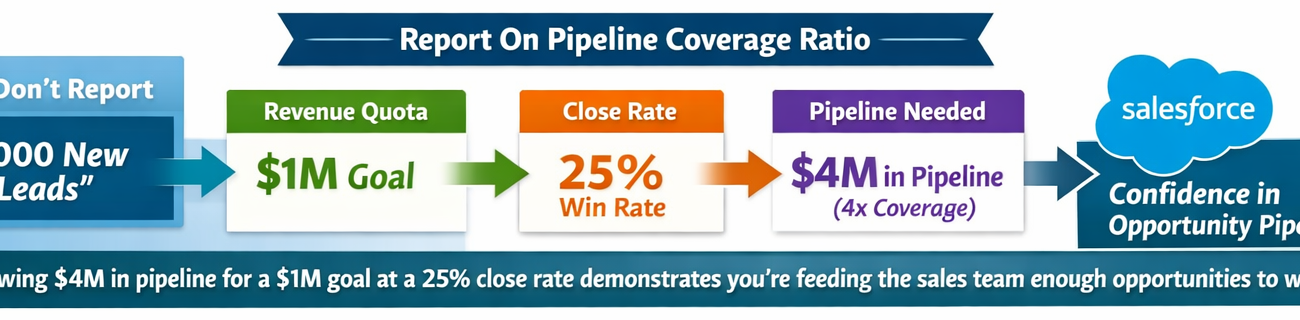
Here is how to break down the “Concept of 4x Coverage” for your executive team:
| Scenario: Your Sales team has a quarterly quota of $1M. | |
| Problem: | Fix: |
| Marketing focuses on lead volume, while Sales focuses on hitting revenue targets. | Report on the pipeline-to-quota ratio. At a 25% close rate, you need $4M in open pipeline to hit a $1M goal. |
| Why This Matters: If you only have $2M in the pipeline (2x coverage), you are statistically likely to miss your target by 50%. This metric acts as an early warning system, allowing you to launch targeted support campaigns before the gap becomes a crisis. | |
2. Sales Cycle Speed
Lead volume matters, but Opportunity Acceleration determines how quickly you turn interest into revenue. That faster sales cycle has real financial value.
The longer an opportunity sits in the pipeline, the greater the risk of stalled deals, higher acquisition costs, and unpredictable forecasting. Tracking sales cycle length by lead source reveals which campaigns and content help prospects move faster.
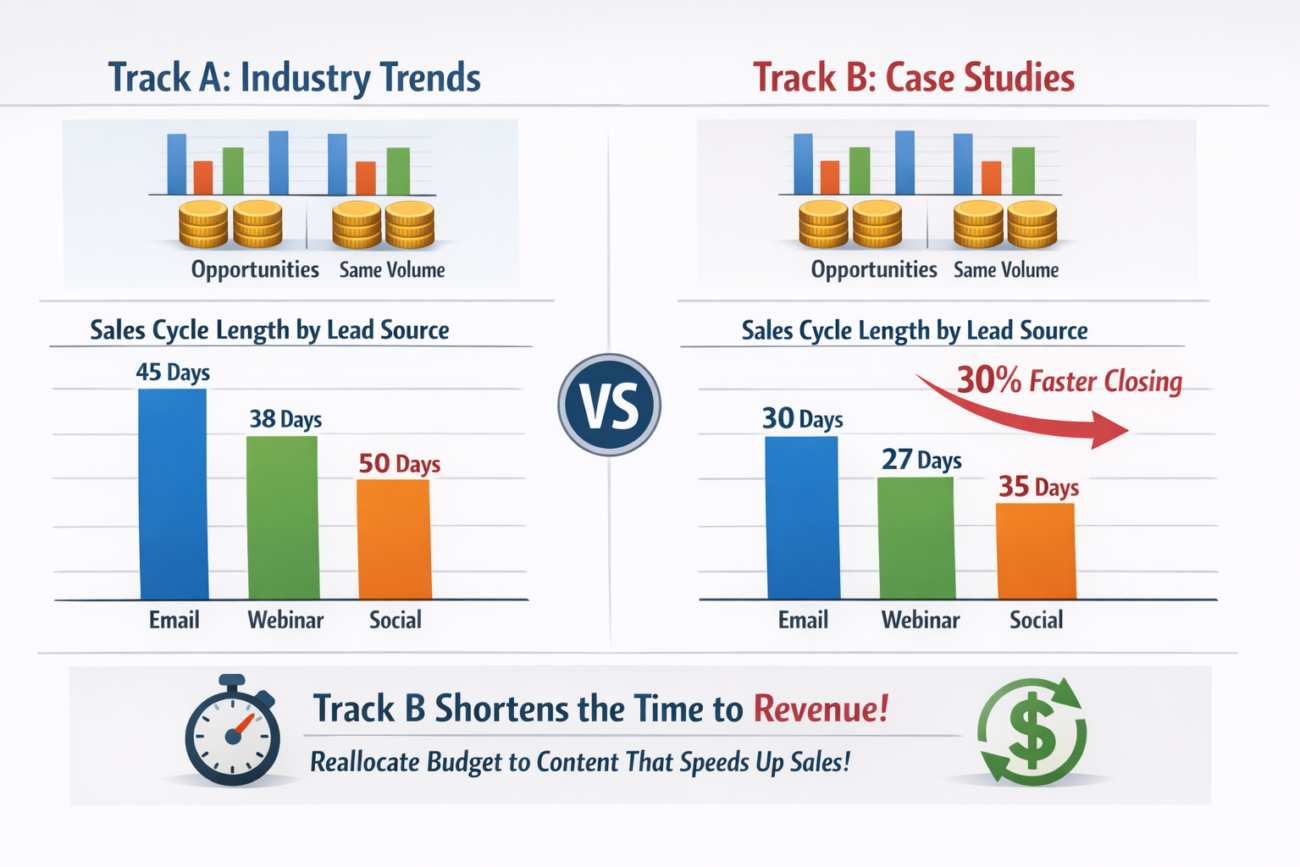
For example, if both nurture tracks generate 20 opportunities, they may look equally successful. But if Industry Trends opportunities take 100 days to close while Case Study opportunities take 70 days, the Case Study track is helping Sales convert interest into revenue 30% faster.
That insight can directly inform budget decisions. Instead of investing based on opportunity volume alone, prioritize the content that helps Sales close faster.
The goal isn’t just to create more opportunities. It’s to create opportunities that move.
| Scenario: You are running two different nurture tracks: one focused on “Industry Trends” (Track A) and one focused on “Case Studies” (Track B). | |
| Problem: | Fix: |
| Two different nurture tracks generate the same number of opportunities, making them look equally successful in a standard report. | Test and track sources and content for each nurture track. |
| Why This Matters: You may find that leads from “Case Study” tracks close 30% faster than “Industry Trend” tracks. Even with identical volume, the faster track is more valuable. You can then logically reallocate the budget to the content that speeds up sales. | |
3. Marketing Contribution to Revenue
When Marketing can demonstrate its impact on revenue, reporting becomes far more valuable. The board doesn’t ultimately care how many leads Marketing generated, how many people attended an event, or how many campaigns you launched. They want to know one thing:
How much revenue did Marketing influence or create?
Marketing Contribution to Revenue answers that question by showing what percentage of closed-won revenue can be attributed to Marketing activity.
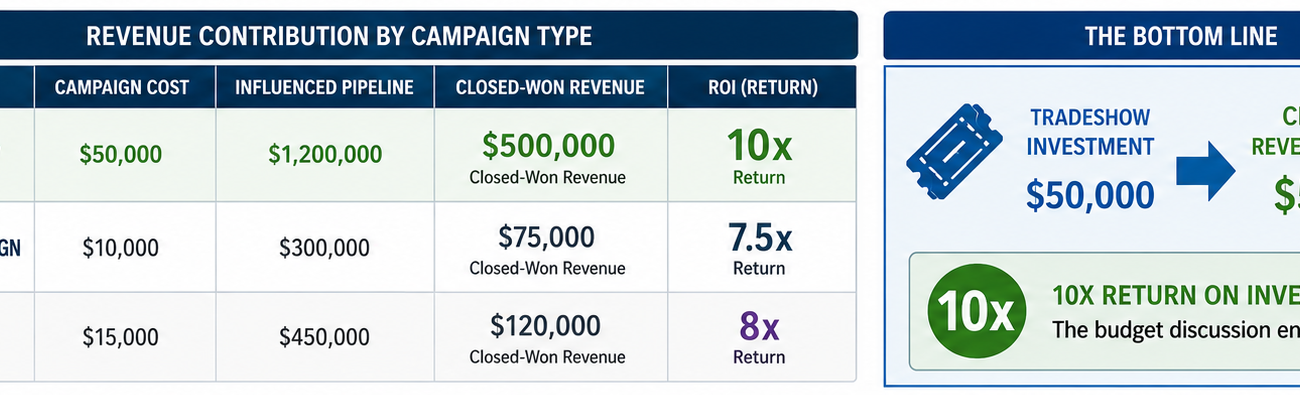
Whether you use sophisticated multi-touch attribution or a simpler First Touch model, connecting campaigns to closed-won revenue gives every marketing dollar a clear connection to the bottom line. Instead of saying, “The budget for the tradeshow was $50K and generated 100 leads” you can say, “This tradeshow influenced $500K in closed-won revenue.”
That’s a very different budget conversation.
The goal isn’t to claim that every campaign directly generated revenue. It’s to build a consistent, credible view of how Marketing contributes to the revenue engine.
Once you can report revenue contribution by campaign type, event, channel, or program, budget decisions become less subjective. You’re no longer asking leadership to believe that tradeshows work. You’re showing them the revenue they influence.
| Scenario: Leadership wants to cut your tradeshow budget. | |
| Problem: | Fix: |
| You know the tradeshows generate quality conversations, but you lack the data to prove the financial return. | Track Revenue Contribution by Campaign Type and Event |
| Why This Matters: Instead of defending the event itself, you are defending a revenue stream. If you can show that a $50k tradeshow influenced $500k in Closed-Won revenue (a 10x return), the budget discussion ends immediately. | |
Conclusion
Your CMO does not need a dashboard filled with email opens, social media followers, and website traffic. They need a clear picture of how your marketing engine is driving the business forward. By shifting your focus to Pipeline Coverage, Opportunity Acceleration, and Contribution to Revenue, you transform your reporting from tactical updates and vanity metrics into strategic boardroom insights.
For a deeper dive into setting up these exact reports, check out our superheroes’ best practices for Marketo and Salesforce alignment.
Bottom line: Vanity metrics might make us feel good, but tying your marketing efforts directly to the pipeline is what truly builds trust with your executive team.