

The traditional attribution scoreboard no longer tells the whole story. In today’s privacy-first environment, focusing on which channel or campaign deserves credit for a deal creates more noise than insight. The way we measure customer journeys has fundamentally changed over the past few years.
Factors such as privacy regulations, third-party cookie deprecation, and fragmented cross-device journeys have made user-level tracking significantly less reliable. Even modern measurement approaches typically capture roughly 50–85% of interactions versus ~85–90% in cookie-based systems, leaving meaningful gaps in visibility.
Attribution can no longer promise precision.
Its value now lies in answering one question:
“Are we confident our marketing strategy is working?”
The Scoreboard Problem
For years, attribution has been framed as a competition:
- Which channel deserves the win?
- Which campaign closed the deal?
- Which touchpoint mattered most?
This mindset turns attribution into a political exercise instead of a strategic one. Teams debate fractional credit, optimize to satisfy dashboards, and chase model perfection while losing sight of buyer behavior. The issue is not poor execution. It is the question being asked.
Traditional attribution asks: “Which interaction deserves the win?”
In today’s privacy-first, multi-device, and non-linear buying journey, that question produces noise, not insight.
For example, a buyer might see a paid social ad on their phone, later search your brand on their laptop, click a retargeting ad, and finally convert after a direct visit. A last-touch model credits “Direct.” A multi-touch model splits credit across channels. Meanwhile, privacy restrictions may hide or fragment several of those interactions entirely.
Each model tells a different story, but none fully reflects reality. The result isn’t clarity. It’s a competing version of the truth.
Confidence Is the Real Objective
Modern attribution must answer a different question:
“Are we confident our marketing efforts are driving predictable growth?”
When you are confident, you know your demand is being created efficiently. It also means your pipeline growth is repeatable and you can predict how increasing or reducing investment in a channel will affect outcomes.
Attribution should inform decisions, not assign blame. Our goal isn’t to prove which single touchpoint closed the deal, but to understand which combination of efforts consistently produces results. No single attribution model can solve this in isolation; it requires a holistic view.
Why Perfect Attribution Is No Longer Possible
No single tool can observe the full customer journey end to end. Any platform claiming “100% attribution” is inevitably modeling or inferring large portions of the data. Even the best marketing superheroes have accepted this reality. Rather than chasing a perfect calculator, they use attribution as a directional signal, a compass that guides investment, experimentation, and scale.
In a world where certainty is unattainable, confidence becomes
the metric that matters most and that can be
achieved by asking the right questions.
The Triangulation Framework
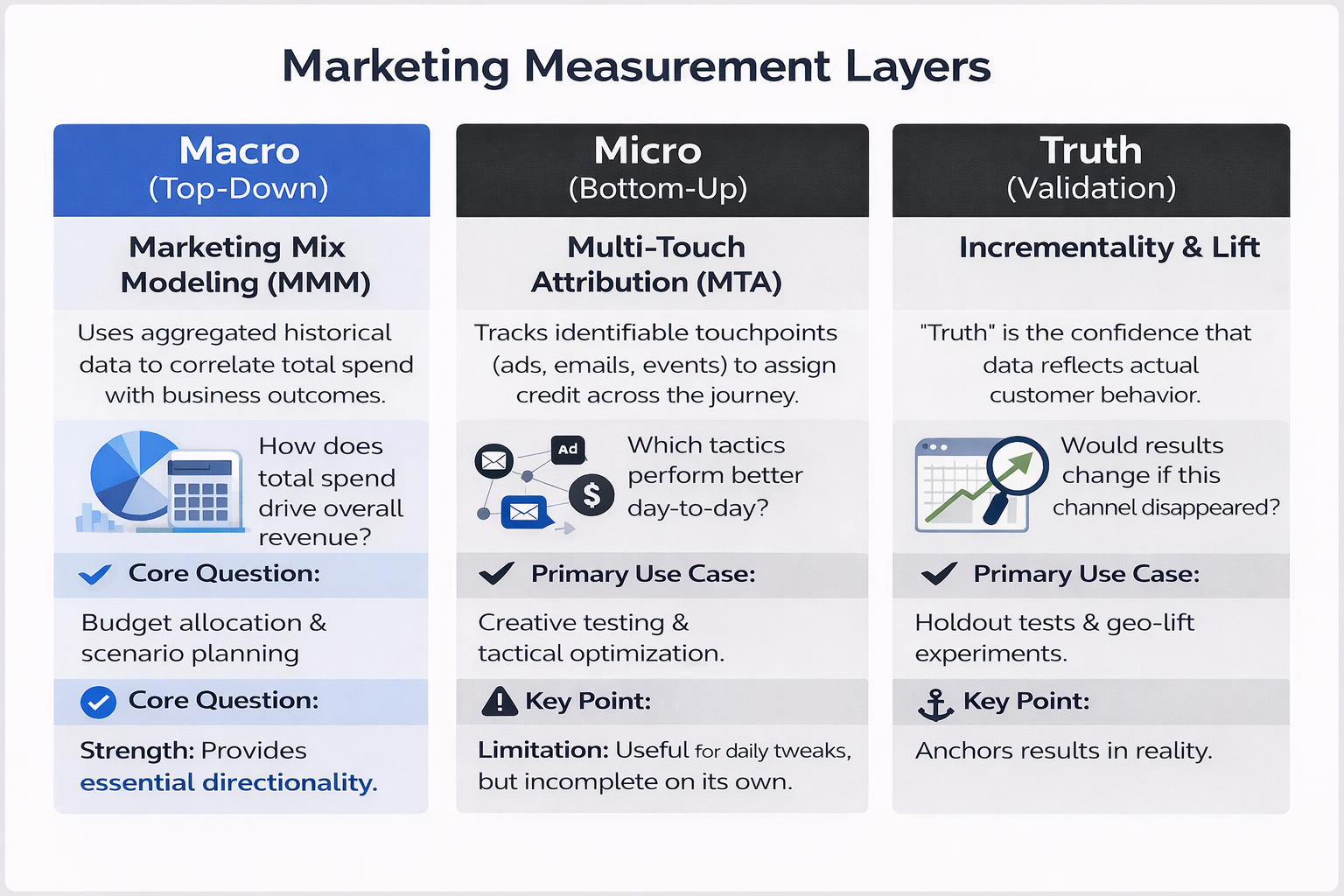
The industry has shifted toward Triangulation: a framework that combines three distinct measurement layers to validate marketing impact.
How to Implement the Confidence Loop
This framework allows you to use attribution as a compass rather than a calculator. No single method is enough on its own. High-performing teams combine all three perspectives:
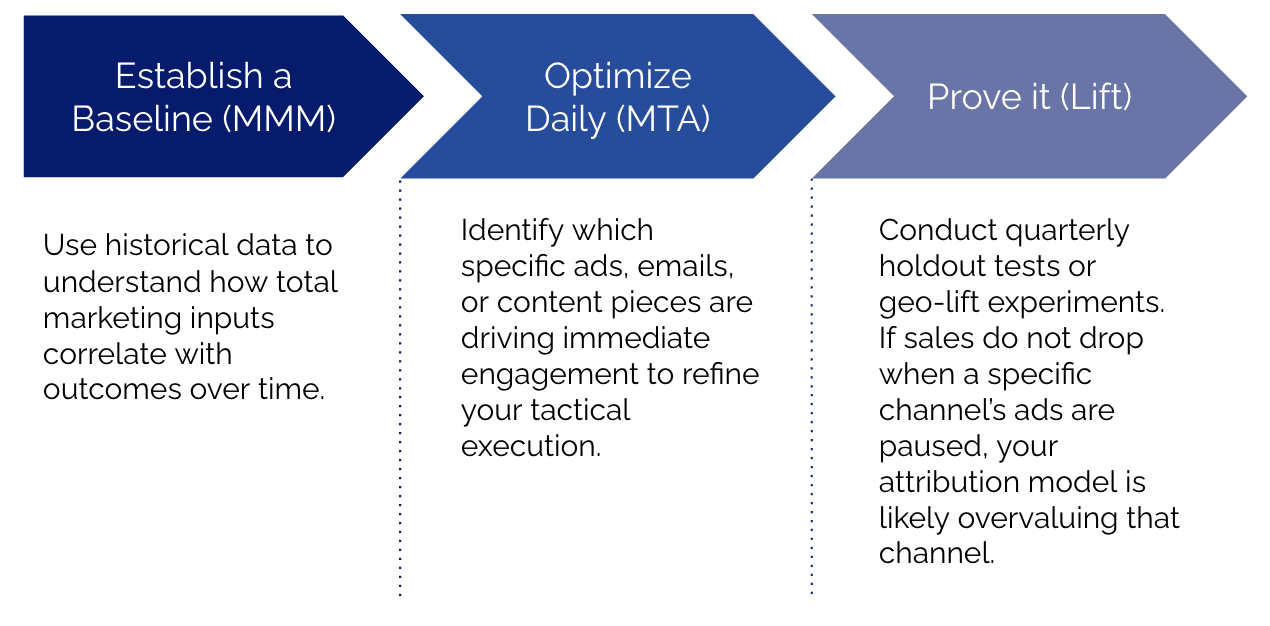
By aligning these independent signals, you gain the confidence that your marketing strategy is a repeatable engine for growth.
Final Takeaway
The bottom line: It’s time to stop asking who gets credit. Start asking whether your strategy is built to drive predictable growth. When your macro, micro, and validation signals align, you stop arguing about credit and start making smarter bets. That’s not just better measurement. That’s a marketing superpower.
To learn more about how Marvel Marketers can help you rethink your attribution, please reach out to a superhero today.
References & Further Reading:
- *Apple: App Tracking Transparency and user privacy documentation (describes ATT opt-in model that reduced cross‑app identifiers)
- Google/Chromium: “Building a more private web” — explains third‑party cookie deprecation and the Privacy Sandbox initiative
- Industry analysis and benchmarks discussing signal loss and attribution limits (examples of vendor/industry writeups showing typical loss ranges and remediation approaches) — ClickZ overview of measurement challenges in a post‑cookie world