

“Dead” doesn’t mean worthless. It means lifecycle stages alone are no longer sufficient to drive your system. The buyer’s journey has evolved, and your technology stack needs to evolve with it.
If your marketing metrics look healthy but your pipeline feels unpredictable, you’re not alone. The disconnect is often hard to identify because your reports and dashboards suggest that everything is performing as expected.
Most teams are still optimizing around lifecycle stages: MQL, SAL, SQL. Yet buyer behavior has evolved beyond these linear frameworks. Today’s B2B purchases involve 6–10 stakeholders (Gartner), span 10+ channels (McKinsey), and don’t necessarily follow a linear path – often with most research happening before Sales is ever engaged.
CMOs are beginning to see the impact of this disconnect. Meanwhile, operations teams, including many of those we partner with, are responsible for bridging the gap.
The Problem: Lifecycle ≠ Reality
Lifecycle models were built for structure, not for behavior.
They assume:
- Linear progression
- One lead = one journey
- Qualification happens once
But what actually happens?
- Buyers revisit pricing pages after going cold
- Multiple stakeholders engage at different times
- “Unqualified” leads can suddenly show intent
When your system only reacts to stage changes, you miss the moments that matter.
Signals tell you what they’re doing now.
The Shift: From Stages to Signals
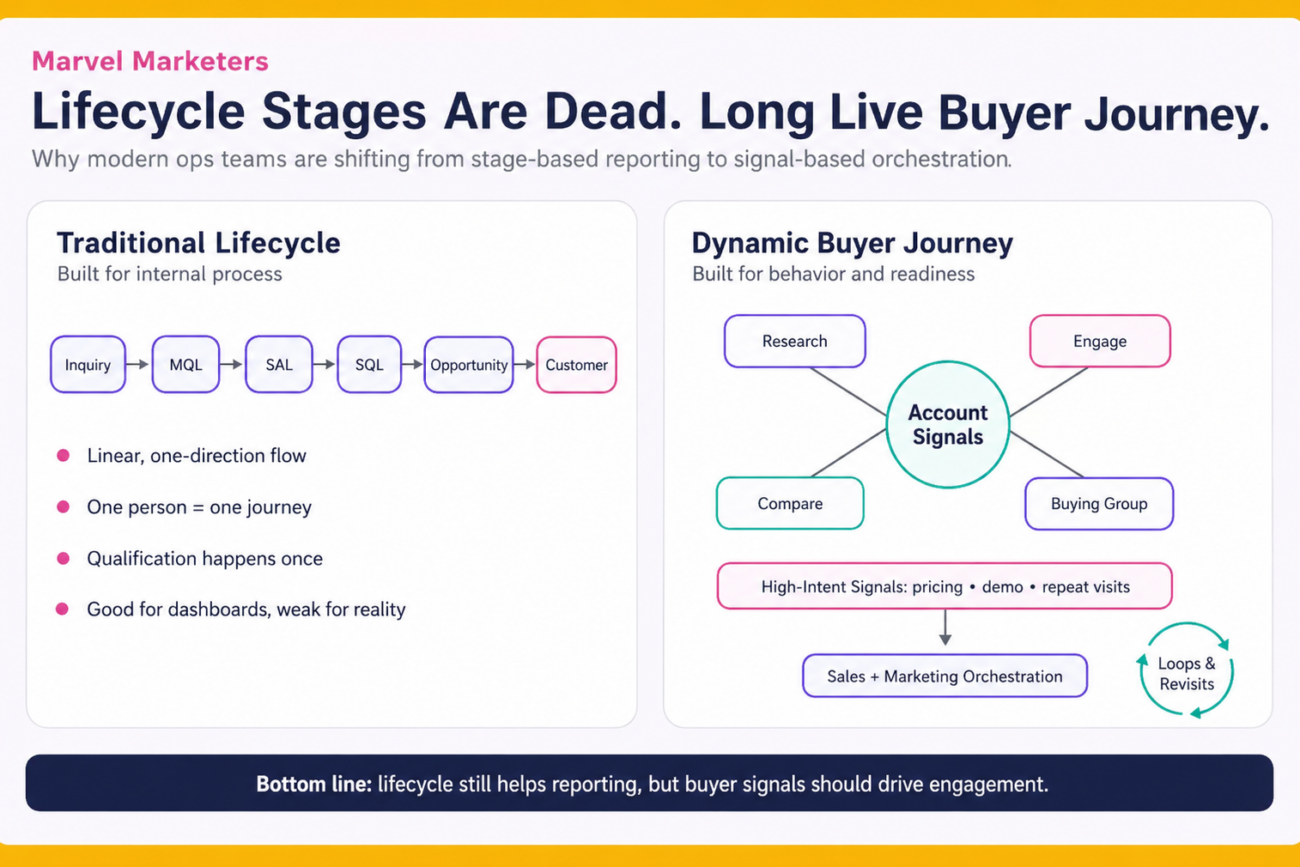
Modern marketing ops teams are shifting from stage-based logic to signal-based orchestration. We’ve seen clients reduce MQL-to-opportunity timelines by weeks and, in some cases, cut response times in half simply by moving from stage-based processes to behavior-driven triggers.
Instead of asking:
“What stage is this lead in?”
They ask:
“What signals show buying readiness right now?”
These signals include:
- Recent engagement (not just score totals)
- Content depth (what they consumed)
- Account activity (how many people are involved)
One person showing intent is interesting. Multiple stakeholders engaging at once is a buying signal. - Velocity (how quickly behavior is increasing)
Imagine a contact goes cold for 60 days, then hits your pricing page three times in a week. A stage-based system does nothing. A signal-based system fires a Sales alert. This is what powers real buyer journey mapping.
In most systems, stage progression is gated by form fills or scoring thresholds, which creates artificial delays between engagement and sales visibility.
What Changes in Your Stack (Practically)
This isn’t a replatforming exercise. It’s a mindset shift in how you build. But it does require reliable data. Signal-based orchestration depends on clean activity tracking, campaign attribution, and CRM sync.
Superhero-Approved Ops Playbook
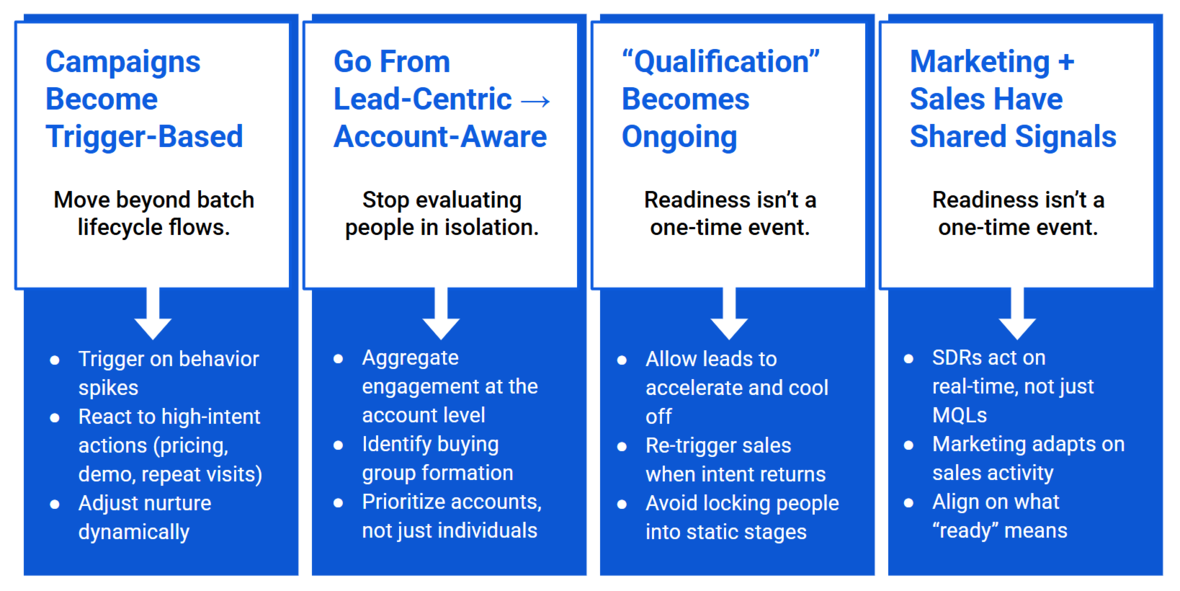
You don’t need to rebuild everything. The best superhero tips and tricks start here:
- Add behavior-based triggers alongside lifecycle flows
- Build account-level engagement views in your CRM
- Redefine MQL using recent activity + intent, not just scoring
- Align SDR + marketing on shared signal definitions
These are small changes – but they can bring your system back in line with how buyers actually behave.
Bottom Line
If your system isn’t built to react to behavior, it’s already behind. Lifecycle stages aren’t useless, but they shouldn’t be what drives your system. The teams outperforming today aren’t tracking where buyers are in a stage. They’re responding to what buyers actually do.
If your system waits for stage changes, it will always be reacting too late.
If you’re rethinking how your lifecycle actually works, this is exactly the kind of problem we help teams solve every day. Please feel free to speak to a Superhero on our team.